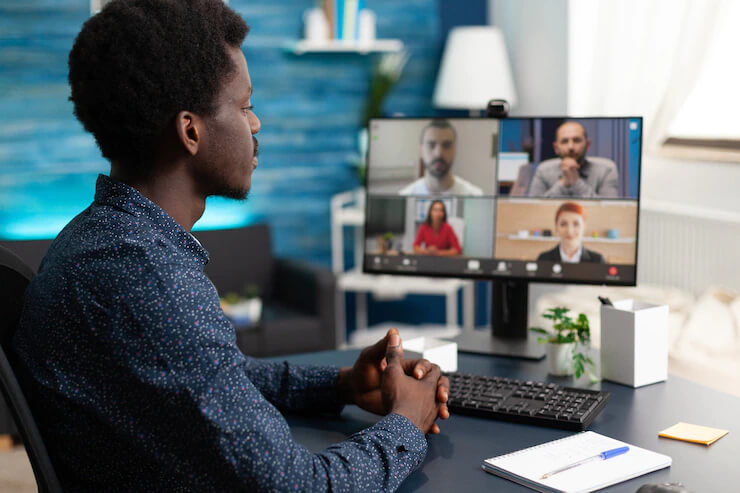
The arrival of the economic crisis and the lockdown period has changed everything. With this life-size exercise on the adoption of telework, we realized that distance could rhyme with productivity. Already more present with the digitization of professions, remote working has recently become massively in practice. The barriers have come down and many companies are now seeing the benefits of remote employment. Thus, employers are considering hybrid modes of organization for the future. We invite you to take a look at the future of teleworking while also shedding light on how it works.
Before the crisis, 1 in 4 employees was teleworking and companies were not in favor of teleworking at the time, but circumstances have changed now. Indeed, during the lockdown, nearly 90% of employers willy-nilly set up teleworking. But what remains today and what will happen in the future?
If 36% of employees already knew about remote work opportunities before the lockdown, for many others teleworking was a discovery. According to the US Mobile Worker Population study by the International Data Corporation, 72% of workers will be working from home in a few months in the United States. But this trend is not unique, it has become Global with the crisis.
Today, 90% of companies are convinced by working from home (whether it is to implement it partially or full time). We can say that lately, teleworking has imposed itself on both companies and employees. In this context, it is quite natural to find new ways of organizing and adapting its management remotely. Collaborative tools, artificial intelligence, and other solutions for remote work are there to allow us to collaborate better remotely.
If remote working has become a matter of course for the future, it is mainly for the following reasons:
- Our society has become more and more mobile, and new communication tools have thus developed.
- We must be able to continue to work, even in a crisis.
- The technology largely allows teleworking through portable equipment and remote software solutions.
- The new generations are already adapted to this mode of organization. They use chat, push-to-talk, the web, and apps to perfection.
- Companies can develop their activities in several territories. The teams must, therefore, be able to communicate with each other remotely.
- Collaboration can now be outsourced, so knowing how to organize remotely is essential.
- Teleworking is generally a source of well-being for employees and improves productivity, according to various studies.
After developing with technological advances, teleworking appears to be one of the organizational methods of today and the future.
If teleworking has a real future in the world of employment, it is because it offers many advantages. For example, it promotes the inclusion of workers with disabilities, improves productivity, and is compatible with many jobs. But to be accessible, inclusive, and productive, teleworking requires the adoption of new practices and the taming of adapted tools. It is therefore still necessary to master the use of technology. Indeed, we are going to be increasingly confronted with online content managers, collaborative practices, conference calls or videos, virtual forums, etc.
Here are some common questions workers have about remote working:
- Can a company impose teleworking on an employee?
- Can an employee choose the days of remote work?
- When we work remotely, do we have to respect schedules?
Employers are answering these questions according to their business needs.
Remote Work Opportunities
With the pandemic and lockdown, teleworking has gained momentum, and this continues after the lockdown. Thus, remote work opportunities extended to too many trades and sectors. If digital technology was the precursor to remote work until now, now everyone is adopting telework and facilitating its implementation. Now it is certain that if you are looking for a remote job, the digital sector has no shortage of opportunities. For example, you can exercise the job of community manager remotely, or the job of remote project Manager as well. Besides, it is very common for web developer positions offered in “fully remote” mode. In general, you will find in the title of the job offers the name of the position followed by the words “telework” or “remote.”
Faced with the crisis, companies now consider that the solution implemented as a priority in the event of a pandemic is teleworking. But it also encourages companies to introduce telework gradually and sustainably for a modern, efficient, and secure professional future.
However, efforts must be made on the part of employers and workers to ensure that the organization of remote work is efficient and peaceful. It’s a fact, teleworking is a trend and it will have to rely on for years to come!
Over 400,000 subscribers love MetroYak. Promote your voice in a highly targeted, personalized way using Promoted Content.
Share your requirements at: hello@metroyak.com